
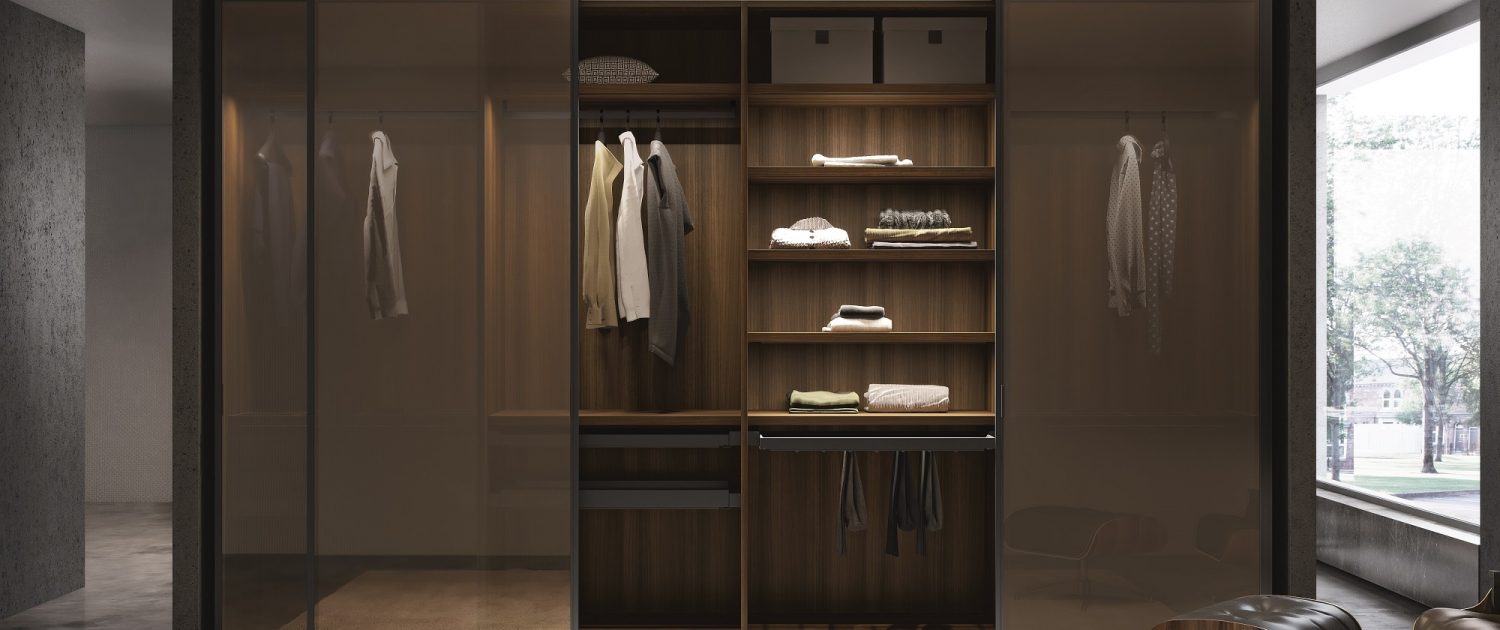
Most dressing rooms fail for one of three reasons: the hanging-to-shelving ratio is wrong for what the owners actually own, there is no ventilation, or there is not enough clear floor to stand back and see yourself. None of those are expensive to get right at drawing stage. All of them are expensive afterwards.
Start with what you own, not with a layout
Before any drawing, count. Long hanging (dresses, coats, kanduras and abayas), short hanging (shirts, jackets, trousers), folded shelving, drawers, shoes, bags. The ratio between those is personal and it varies enormously — a couple where one person hangs almost everything and the other folds almost everything needs an asymmetric design, not two matching halves.
Useful planning figures:
- Long hanging — allow around 1,500–1,800mm of height.
- Short hanging — around 1,000–1,100mm, which lets you double-hang and gain a great deal of capacity.
- Depth — 600mm for hanging. Anything less and shoulders touch the back and clothes crease.
- Clear floor — at least 1,000mm in front of any run, and more if there are drawers you need to open fully while standing back.
Ventilation — the mistake we see most in the UAE
This matters far more here than in a temperate climate and is almost always overlooked. A sealed wardrobe in a villa that runs air conditioning hard, in a city with high outdoor humidity, becomes a cool enclosed box. Open the door on a humid day and moist air enters and condenses. Leather bags develop mould, and it happens within a single summer.
What to do about it, in order of effectiveness:
- Do not seal the carcass fully — allow air movement through and behind it.
- Keep the AC serving the dressing room rather than treating it as a cupboard outside the cooled envelope.
- Ventilated shelving for bags and shoes rather than solid boxes.
- Avoid an external wall backing where you can, or insulate behind it — condensation forms on the coldest surface.
This is a specification decision that costs almost nothing at drawing stage and is genuinely difficult to fix once the joinery is installed.
Lighting
Overhead light alone puts your own shadow onto everything you are looking at. What works:
- Vertical lighting in the hanging sections, so garments are lit from the side rather than from above.
- Shelf-edge or under-shelf strips for folded items and shoes.
- A mirror lit from both sides, at face height, if you dress there.
- Warm-white, high colour rendering. Cheap cool-white LEDs make it impossible to judge navy against black, which is the one job dressing-room lighting has.
- Sensor-switched per section, so opening a door lights only what you opened.
The island question
An island is the feature people want and the thing most often shoehorned in. It needs the clear floor either side, not instead of it. As a rule: below about 3.5 metres of room width, an island will make the room worse. A bench or a drawer run against a wall usually delivers more.
Details worth paying for
- Soft-close on everything, including internal drawers.
- Pull-out trouser and tie racks — far more capacity per millimetre than hanging.
- Adjustable shelving. What you own changes; fixed shelves date fast.
- Full-height doors rather than a separate top box, which collects dust and is unreachable.
- Dust seals on frequently-opened doors — Dubai dust finds everything.
Common mistakes
Matching halves for two people who store completely differently. Too much folded shelving — most people hang more than they think. Deep corner voids that swallow things forever. Mirrors opposite windows, which glare rather than help. No seating, when putting shoes on standing is the daily annoyance nobody accounts for.
Have it measured properly
Villa walls here are rarely square, and a dressing room is where that shows — a 15mm discrepancy across a run of doors is visible. We survey, then draw the wardrobe interiors around what you actually own, and specify from manufacturers who will build to those drawings rather than to a standard module. Request a quote, or see how we handle fitted furniture and kitchens.